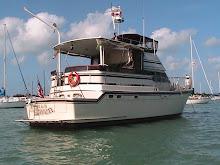
Our little stay in Green Turtle gave me a chance to resurrect the generator. I turned out that it had a number of electrical problems (a high temperature cut-out switch, an internal relay and one major power junction) that were probably a result of having being exposed to a salt fog from water escaping from the faulty exhaust elbow last season and then being exposed to the heat and humidity of Florida over the summer. Once I found and eliminated all of these, the generator started and ran better than ever - at least for a short time. Then it sprung a leak around the thermostat housing, flooding the area with lots of steam. For a few moments, until we knew that we were dealing with steam and not smoke, it was more than a little scary. Replacing the lost anti-freeze and tightening a few bolts solved the issue, however.
We also used the time in Green Turtle to resurrect the fly-bridge depth sounder. It seemed that I had simply plugged two halves of a multi-pin cable together incorrectly. To look at it, you would not think this was possible but I guess it was.
Once we reached Treasure Cay, I was faced with the task of cleaning the diesel out of the bilges. What do you do with several gallons of sea-water contaminated diesel once you suck it out of the bottom of the boat? I use the verb suck since a shop-vac was the best way of skimming it off the surface. Lucky for us, one of the families we met at Treasure Cay had bought a property lot and was clearing it of bush. Dirty diesel was useful to them to help burn the brush piles. We were happy to get rid of it and they were happy to have access to our dirty diesel - truly a win-win situation.
When we first fired up out dingy, the outboard ran very poorly. Now that it has had a few tanks of fuel flushed through it, it runs much better. Notwithstanding that it had lots of Stabil added to the fuel and then was run dry before storage, I think the carburetor had some gum in it. It is not often that mechanical problems fix themselves so I guess I should be grateful.
I find that even now, I am still learning the boat and its systems. And I am still doing the occasional bone-head trick. Just the other day, now that we had clean bilges, I failed to screw the dip stick on the generator properly into its hole. As a result, it shook loose, allowing 2 quarts of oil to be blown out and into the bilge. Yuck!! Now bilge cleaning can start all over.
Anyway, (touch wood) the boat seems to be running well and I continue to gain confidence in it. While I do not claim to be truly mechanically competent (sometimes I create more problems than I solve), I continue to be boggled by people who set out to live this lifestyle in spite of no mechanical competence whatsoever.
Monday, February 7, 2011


Sunday, February 6, 2011
Getting Started, Crossing the Gulf, near disaster at the Whale
As we finalized our preparations to head for the Bahamas, we were joined by our friends Gerry and Pam.
Gerry helped me bring the R&B Haven down the St Lucie River as far as Manatee Pocket near Stuart. This was where we would stage while waiting to cross the Gulf Stream. Pam helped Bev complete provisioning and then we were ready to go.
 Happy Hour at Finz at Manatee Pocket
From left to right: Ray, Gerry, Pam, Bev and myself (Rob)
I am always a bit nervous about crossing the Gulf Stream. The weather was promising to be good; a light wind out of the East or South East. The previous day, it had been blowing lightly from the North East so we could expect a bit of a cross chop but nothing huge. My problem is that my imagination is too good and I imagine all the things that could go wrong!
As things turned out, nothing went wrong. The weather was good. Once we hit the Gulf Stream, we did hit a bit of a chop. Tuck (one of our dogs) was seasick. Yuck!! But by mid afternoon, it was all over.

Sunrise on the Gulf Stream
On the day we crossed, we did almost 100 nautical miles, leaving our anchorage at 5:30 AM and arriving at Mangrove Cay in the evening dusk around 6:30 PM after running all day at 8 knots. Our usual cruising speed is 7 knots, but we prefer to get the crossing out of the way in the daylight to the extent we can. So we trade fuel for time.
The next day, we started out cruising at a liesurely rate towards an island called Allans-Pensacola. The wind was from the South-West. Around noon I became worried that there were no good anchorages between us and Green Turtle that would be sheltered from all directions if a front went through.
We were not in range of any weather forecasts to confirm but thought we had better err on the side of caution. We realized that we could just make Green Turtle around sunset if we dialed the boat up to 8.5 knots, again trading fuel for time. The entrance to Green Turtle is not lit. It is shallow and it is narrow. A night time entrance would be hairy.
It turned out that Bahamian Customs is now open 7 days/week at Green Turtle (New Plymouth) so we were checked in first thing the next morning (Saturday) by a very pleasant and polite young lady. These customs officials are your first contact with the people who live in the Bahamas. Our experiences have been nothing but positive.
A front did go through that evening (with winds hitting 80 km/hr or 50 mph) so we were glad to be snug.
On Sunday, we explored Manjack island, meeting former cruisers, Leslie and Bill, who had swallowed the anchor there. They welcome cruisers to use their dock and to access the trails across the island.
On Monday, we decided to see if we could cross the Dont Rock passage leading from the Green Turtle area to the Sea of Abaco area feeding into Marsh Harbour. The alternative was to go around the Whale Passage but it sounded as if it might be a bit rough.
As we got closer to the entrance to the Dont Rock passage, we could see breakers right across. As we got even closer, I realized that the breakers were about 200 yards from our side of the entrance of the passage, and that if you could get past the breakers, the rest of the passage and its exit were smooth. I decided to run with the waves a bit to see where the breakers petered out and to see if there was a reasonable way around.
Then disaster almost hit. We broached in the waves. Beverley felt she could almost touch the water by reaching out from her window on the flybridge. In reality, we probably heeled over about 35 to 40 degrees (still lots). It felt as if the lee rail was going to go under and although this is a normal mode of operation for sail boats, I don't think that power boats are supposed to operate this way. So, once the boat had spun that far around, I just cranked the wheel over so that we took the next wave bow on.
We then checked out the Whale Passage, but I could see breakers right across it. We were not going there so we turned around and headed back to Manjack Island. Upon anchoring, we noticed a strong smell of diesel.
The spare propeller had come loose, smashing one of the fuel filters and creasing the oil filter.
 Red died diesel in bilge. Good thing this was not gasoline or we would probably not we here to write this.

Crushed fuel filter. It is incredible that this engine still ran.

Creased oil filter. It is lucky that this was not punctured.
Cleaning up this mess was to take a lot of work, but we were incredibly lucky not to have been in real trouble (e.g. engine loss in steep seas, destruction of engine because of loss of oil, explosion if a gas engine).
So we changed filters, bled the system and returned to Green Turtle where we played tourist over the next several days until things really calmed down.

Bbqing on the after deck.

Bev and I in the Green Turtle anchorage. Life is good!

New Plymouth Harbour

Bev and friends Gerry, Dick and Laurie touring New Plymouth by golf cart. Bev's foot was operated on late November so she was still limited in how far she could walk without a lot of discomfort.

Small Westerley sailboat with their anchor rode tangled in our propeller at 2:00 AM. The guys on board were from Montreal and were really glad we did not get really excited. The previous night, we had seen them coming up the channel at midnight, in the middle of a thunderstorm only to anchor right beside us. We did not realize it at the time, but apparently they had dragged from the other end of the anchorage, right down the narrow channel, only to awaken in the mangroves at its entrance. It is a marvel that they made it that far.
Our time at Green Turtle was relaxing but between storm anchor watches and wandering boats, we did not have many uninterrupted nights sleep. We were looking forward to getting to Treasure Cay where we had been promised a free night's stay at the dock.
Gerry helped me bring the R&B Haven down the St Lucie River as far as Manatee Pocket near Stuart. This was where we would stage while waiting to cross the Gulf Stream. Pam helped Bev complete provisioning and then we were ready to go.

From left to right: Ray, Gerry, Pam, Bev and myself (Rob)
I am always a bit nervous about crossing the Gulf Stream. The weather was promising to be good; a light wind out of the East or South East. The previous day, it had been blowing lightly from the North East so we could expect a bit of a cross chop but nothing huge. My problem is that my imagination is too good and I imagine all the things that could go wrong!
As things turned out, nothing went wrong. The weather was good. Once we hit the Gulf Stream, we did hit a bit of a chop. Tuck (one of our dogs) was seasick. Yuck!! But by mid afternoon, it was all over.

Sunrise on the Gulf Stream
On the day we crossed, we did almost 100 nautical miles, leaving our anchorage at 5:30 AM and arriving at Mangrove Cay in the evening dusk around 6:30 PM after running all day at 8 knots. Our usual cruising speed is 7 knots, but we prefer to get the crossing out of the way in the daylight to the extent we can. So we trade fuel for time.
The next day, we started out cruising at a liesurely rate towards an island called Allans-Pensacola. The wind was from the South-West. Around noon I became worried that there were no good anchorages between us and Green Turtle that would be sheltered from all directions if a front went through.
We were not in range of any weather forecasts to confirm but thought we had better err on the side of caution. We realized that we could just make Green Turtle around sunset if we dialed the boat up to 8.5 knots, again trading fuel for time. The entrance to Green Turtle is not lit. It is shallow and it is narrow. A night time entrance would be hairy.
It turned out that Bahamian Customs is now open 7 days/week at Green Turtle (New Plymouth) so we were checked in first thing the next morning (Saturday) by a very pleasant and polite young lady. These customs officials are your first contact with the people who live in the Bahamas. Our experiences have been nothing but positive.
A front did go through that evening (with winds hitting 80 km/hr or 50 mph) so we were glad to be snug.
On Sunday, we explored Manjack island, meeting former cruisers, Leslie and Bill, who had swallowed the anchor there. They welcome cruisers to use their dock and to access the trails across the island.
On Monday, we decided to see if we could cross the Dont Rock passage leading from the Green Turtle area to the Sea of Abaco area feeding into Marsh Harbour. The alternative was to go around the Whale Passage but it sounded as if it might be a bit rough.
As we got closer to the entrance to the Dont Rock passage, we could see breakers right across. As we got even closer, I realized that the breakers were about 200 yards from our side of the entrance of the passage, and that if you could get past the breakers, the rest of the passage and its exit were smooth. I decided to run with the waves a bit to see where the breakers petered out and to see if there was a reasonable way around.
Then disaster almost hit. We broached in the waves. Beverley felt she could almost touch the water by reaching out from her window on the flybridge. In reality, we probably heeled over about 35 to 40 degrees (still lots). It felt as if the lee rail was going to go under and although this is a normal mode of operation for sail boats, I don't think that power boats are supposed to operate this way. So, once the boat had spun that far around, I just cranked the wheel over so that we took the next wave bow on.
We then checked out the Whale Passage, but I could see breakers right across it. We were not going there so we turned around and headed back to Manjack Island. Upon anchoring, we noticed a strong smell of diesel.
The spare propeller had come loose, smashing one of the fuel filters and creasing the oil filter.


Creased oil filter. It is lucky that this was not punctured.
Cleaning up this mess was to take a lot of work, but we were incredibly lucky not to have been in real trouble (e.g. engine loss in steep seas, destruction of engine because of loss of oil, explosion if a gas engine).
So we changed filters, bled the system and returned to Green Turtle where we played tourist over the next several days until things really calmed down.
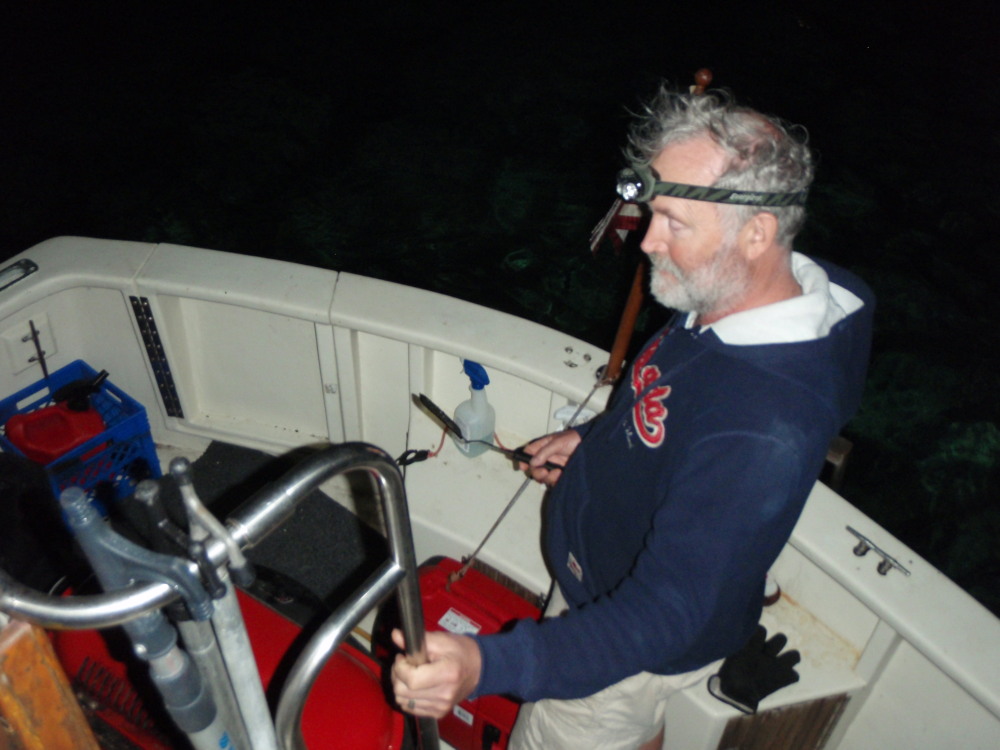
Bbqing on the after deck.

Bev and I in the Green Turtle anchorage. Life is good!

New Plymouth Harbour

Bev and friends Gerry, Dick and Laurie touring New Plymouth by golf cart. Bev's foot was operated on late November so she was still limited in how far she could walk without a lot of discomfort.

Small Westerley sailboat with their anchor rode tangled in our propeller at 2:00 AM. The guys on board were from Montreal and were really glad we did not get really excited. The previous night, we had seen them coming up the channel at midnight, in the middle of a thunderstorm only to anchor right beside us. We did not realize it at the time, but apparently they had dragged from the other end of the anchorage, right down the narrow channel, only to awaken in the mangroves at its entrance. It is a marvel that they made it that far.
Our time at Green Turtle was relaxing but between storm anchor watches and wandering boats, we did not have many uninterrupted nights sleep. We were looking forward to getting to Treasure Cay where we had been promised a free night's stay at the dock.
Friday, February 4, 2011
2011 Winter Season
Hello Blog.
It is February 4, 2011 and we are currently anchored at Marsh Harbour. This is the Bahamas' third largest city. It is so big that it even has a traffic light. Before you snicker, be aware that this traffic light is a very important land mark. Everything is so many blocks this way and so many blocks that way from the light. From that perspective, it is very useful.
I have been waiting for a rainy, crappy day to write this blog. It has not happened, so I am doing it in 80F, sunny weather. Call me crazy.
Let me break our recent experiences into historical chunks starting with preparing the R&B Haven for this year's sun and fun in the Sea of Abaco.
Someone said that cruising consists primarily of fixing your boat in exotic locations.
Maybe. I certainly spend a lot of time fixing our boat. But Indiantown Florida? It is not exactly an exotic location. That is where we had stored our boat over the summer and where we had to prepare it to be launched and to be used as our home over the next several months.
I had projected 10 days of work before we went down there and it took 10 days to get the boat ready for the water. The difference between my projections and what actually transpired was that we did a number of things that I had not anticipated and dropped off the list some things that would be really nice to do but were not essential.
Mould was a bigger issue than expected. Unfortunately, I had loosely plugged with screening material, all the through hulls that did not have seacocks. Unfortunately, the deck drain screens plugged solid with debris and the water then backed up in the internal downtubes until it seeped through the bilge pumps into the hull. This provided a ready source of humidity and humidity leads to mould growth. It also leads to corrosion of electrical things. This was a bad mistake and one that I will avoid next year. Because of it, we had to do a lot of extra cleaning. Just to be sure, I have installed a couple of supplementary drains: one in the transom and one at the bottom of the keel so that next year, water will not be able to accumulate.
Our refrigerator also died. Rather than replace it with a dual voltage version, we bought a deeper and taller 120 volt fridge at Lowes. The price difference was substantial ($1500 vs $400) and the the dual voltage fridge always ran on 120 volts anyway since the inverter is always running in order to service the chest freezer. The new fridge seems to use more power, but it is also much larger. On the whole, we (meaning Bev) are pleased.
I had lowered the old refrigerator to the ground using ropes and the crane that is for lifting the dingy onto the roof. I was prepared to do the reverse with the new fridge. After tying the ropes and hooking it to the crane, I went looking for help from neighbouring boats in the boatyard. This really big black guy comes over and he picks up the new fridge, hefts it a few times and says "We don't need all these ropes and things. Why don't I just pass it up (over his head) to someone standing in the boat?" That is exactly what he did. He was certainly a better man than I ever was or even ever dreamed of being.
Life is good when you can get help - especially good help.
 While I was working inside the hull, Bev did yeoman's service sanding and painting the hull.
 Here is Bev painting. Now this is a woman worth marrying.
Of course, there are some costs. She wanted rewards. She had not previously told me about her Indian heritage and the fact that one of her ancestors was from the Blackfoot tribe.

The biggest error in time to repair estimate concerned the generator. I had "budgeted" 4 hours to install a new exhaust elbow. In fact, it took me 12. I could not just unscrew it. I had to remove the whole exhaust manifold in order to have the space to turn it in a full circle. Of course, it broke into pieces when I put some torque on it when it was still in place in order to loosen it up. In order to remove the exhaust manifold, you have to remove the heat exchanger and the bracket that holds it in place. All of this is in a restricted cubbyhole. If the whole thing was on a workbench, it would be easy. In fact, I had to take the manifold to someone with an oxy-actelyne torch and a 4 foot long pipe wrench in order to separate the elbow from the manifold. But in the end, it all went back together as it should. I then stuck its sea water intake hose into a bucket and, miracle of miracles, it started right up.
I thought this meant that the generator would run without problems this year. Man, was I sucked in!!!
Much of the work was just normal maintenance or undoing the things that we had done to prepare the boat for storage or the possibility of a hurricane.

Reinflating the dingy and installing its outboard.
The work seemed to take forever since we were living on the boat in the boatyard while working on it. Finally, however, it was ready to be launched.

Launch time!!
Yahoo!
Once the boat was in the water, the main engine started right up, just as it had in the boat yard. The generator ran for about 60 seconds and then died, not to be recussitated. Good thing we had the Honda 2000 watt generator as a back-up as it meant that would continue.
While this was going on, Bev was working full time at grocery shopping for essential provisions (wine, beer and food). Then ready or not, there was a weather window approaching where we could cross to the Bahamas and we were set to go.
It is February 4, 2011 and we are currently anchored at Marsh Harbour. This is the Bahamas' third largest city. It is so big that it even has a traffic light. Before you snicker, be aware that this traffic light is a very important land mark. Everything is so many blocks this way and so many blocks that way from the light. From that perspective, it is very useful.
I have been waiting for a rainy, crappy day to write this blog. It has not happened, so I am doing it in 80F, sunny weather. Call me crazy.
Let me break our recent experiences into historical chunks starting with preparing the R&B Haven for this year's sun and fun in the Sea of Abaco.
Someone said that cruising consists primarily of fixing your boat in exotic locations.
Maybe. I certainly spend a lot of time fixing our boat. But Indiantown Florida? It is not exactly an exotic location. That is where we had stored our boat over the summer and where we had to prepare it to be launched and to be used as our home over the next several months.
I had projected 10 days of work before we went down there and it took 10 days to get the boat ready for the water. The difference between my projections and what actually transpired was that we did a number of things that I had not anticipated and dropped off the list some things that would be really nice to do but were not essential.
Mould was a bigger issue than expected. Unfortunately, I had loosely plugged with screening material, all the through hulls that did not have seacocks. Unfortunately, the deck drain screens plugged solid with debris and the water then backed up in the internal downtubes until it seeped through the bilge pumps into the hull. This provided a ready source of humidity and humidity leads to mould growth. It also leads to corrosion of electrical things. This was a bad mistake and one that I will avoid next year. Because of it, we had to do a lot of extra cleaning. Just to be sure, I have installed a couple of supplementary drains: one in the transom and one at the bottom of the keel so that next year, water will not be able to accumulate.
Our refrigerator also died. Rather than replace it with a dual voltage version, we bought a deeper and taller 120 volt fridge at Lowes. The price difference was substantial ($1500 vs $400) and the the dual voltage fridge always ran on 120 volts anyway since the inverter is always running in order to service the chest freezer. The new fridge seems to use more power, but it is also much larger. On the whole, we (meaning Bev) are pleased.
I had lowered the old refrigerator to the ground using ropes and the crane that is for lifting the dingy onto the roof. I was prepared to do the reverse with the new fridge. After tying the ropes and hooking it to the crane, I went looking for help from neighbouring boats in the boatyard. This really big black guy comes over and he picks up the new fridge, hefts it a few times and says "We don't need all these ropes and things. Why don't I just pass it up (over his head) to someone standing in the boat?" That is exactly what he did. He was certainly a better man than I ever was or even ever dreamed of being.
Life is good when you can get help - especially good help.


Of course, there are some costs. She wanted rewards. She had not previously told me about her Indian heritage and the fact that one of her ancestors was from the Blackfoot tribe.

The biggest error in time to repair estimate concerned the generator. I had "budgeted" 4 hours to install a new exhaust elbow. In fact, it took me 12. I could not just unscrew it. I had to remove the whole exhaust manifold in order to have the space to turn it in a full circle. Of course, it broke into pieces when I put some torque on it when it was still in place in order to loosen it up. In order to remove the exhaust manifold, you have to remove the heat exchanger and the bracket that holds it in place. All of this is in a restricted cubbyhole. If the whole thing was on a workbench, it would be easy. In fact, I had to take the manifold to someone with an oxy-actelyne torch and a 4 foot long pipe wrench in order to separate the elbow from the manifold. But in the end, it all went back together as it should. I then stuck its sea water intake hose into a bucket and, miracle of miracles, it started right up.
I thought this meant that the generator would run without problems this year. Man, was I sucked in!!!
Much of the work was just normal maintenance or undoing the things that we had done to prepare the boat for storage or the possibility of a hurricane.

Reinflating the dingy and installing its outboard.
The work seemed to take forever since we were living on the boat in the boatyard while working on it. Finally, however, it was ready to be launched.

Launch time!!
Yahoo!
Once the boat was in the water, the main engine started right up, just as it had in the boat yard. The generator ran for about 60 seconds and then died, not to be recussitated. Good thing we had the Honda 2000 watt generator as a back-up as it meant that would continue.
While this was going on, Bev was working full time at grocery shopping for essential provisions (wine, beer and food). Then ready or not, there was a weather window approaching where we could cross to the Bahamas and we were set to go.
Monday, April 26, 2010
Gulfstar 38 - Wild Steering Characteristics and Rudders
While not supremely evil, the steering characteristics of the R&B Haven were often challenging – particularly in following seas of any size. From talking to other powerboat owners, I understand that this is often the case.
To my way of thinking, the steering of the R&B Haven was unusual in its need to be constantly countersteered in order to make the boat go straight. Once a turn was initiated either through an external force such as a wave or by a slight turn of the rudder, the turn would continue until you countersteered - in spite of the fact that the rudder was centered. In the absence of intervention, often the rate of turn would even accelerate – all by itself.
This meant that if the boat yawed to the left, you had to first steer to the right and then as you caught the yaw, you had to immediately start turning the wheel towards the neutral position in order not to oversteer. As the boat swung to the right, back towards the desired course, you then had to actively countersteer to the left in order to slow and then to stop the swing to the right at the desired heading. You then had to turn the wheel back to the right and back to the neutral position before an undesired turn to the left was initiated.
I don't know if this is normal for a Gulfstar 38 or if it is because of the cockpit which was added at the factory without repositioning the rudder or the prop.
In calm seas, I could learn to anticipate and to steer in a relatively straight course. It required constant attention, however, and the autopilot could not learn to do this. At best, the autopilot would deviate about 10 degrees on either side of the desired course (20 degrees total). In a following wind, it was pretty hopeless. In following seas over 3 feet, when steering manually, I was very, very busy trying to maintain an even remotely straight course.
My good friend, Bruce, on advice of an old Newfoundland fisherman, suggested I consider modifying the rudder so that it become what is known as a “fishtail rudder”. Bruce's fisherman friend suggested a simple sounding solution: weld a piece of angle iron to the tailing edge of the rudder. There were two challenges to this solution: the rudder is fiberglass and welding to it is not easily done and secondly, it was underwater.
As a test, I cobbled something together made of aluminum extrusions. The idea was to clamp it to the trailing edge of the rudder as a proof of concept. Because we were then cruising in the Sea of Abaco where there are no large waves, it took me a while to get a round to it. Eventually, I did bolt it into place and then modified it to see if there was a more optimal solution.
The rest of this story will tell what I found.
When my friend Bruce originally suggested this rudder modification, I thought he had consumed too much “Newfie” Screech (rum) and had taken leave of his senses. Attaching a piece of angle iron to the trailing edge of a rudder made no sense to me at all. I thought it would create a lot of unnecessary drag and that would be it.
Upon doing some internet research, I found that the idea has been around for a while and apparently is catching on in ship design. Apparently, it makes the rudder almost as effective as an articulated rudder, but without the complications.
The rudder on the R&B Haven is about 2 ½ feet deep and about 1 ½ feet fore and aft. The trailing edge is about ¾ inches wide. The attachment I made clamped to the trailing edge of the rudder. It then narrowed in at a 30 degree angle (on each side) to its narrowest section, approximately 3/8 inches thick. From here, it flared out at a 30 degree angle to a total width of ¾ inches. From here, it flared an additional 15 degrees (45 degrees off the centerline or 90 degrees total) so that the total width of the flare was about 1 ¾ inches.
A sketch showing 3 design iterations follows.


With the orignl attachment in place, the helm felt very heavy. Steering control was greatly improved but I had a feeling that we might be losing 1/3 to ½ knot. It was difficult to tell, however, since we only used this configuration in 25 knot winds and our loss of speed may have been solely due to currents, waves and winds.
I then removed the tail sections of my little invention. The steering was still significantly better than before the fishtail was added to the rudder and there was no loss in speed in calm conditions. Also, the helm did not fee nearly so heavy. I seriously considered just leaving the rudder in this stage of development.
Rather than leaving well enough alone, I decided that while I had the chance, I really ought to try a third configuration where I straightened the last flaring pieces and reinstalled them. All of the flare was then at 30 degrees from the centerline. This configuration seems to perform exactly in the middle of the other two, exactly as you might expect. The only difference is that there is no apparent speed loss in calm conditions. In calm conditions under autohelm the boat weaves about 2 to 3 degrees to each side of its mean course. Going into waves, it performs extremely well, returning to its desired course quickly and will little overshoot when knocked off by a wave. In following seas, it still wanders a bit. These latter conditions are ones where the old rudder was completely hopeless. In moderate following or quartering seas (3 to 4 feet), it probably does at least as well as I do (plus or minus 10 degrees from the desired course) since its attention span is longer.

I am declaring this design a success!
Now I just have to replace the aluminum trial attachment with a permanent fiberglass fishtail. At the same time, I think I will add an endplate and will extend the front of the rudder a little in order to lighten the helm.
Bruce, thank you for passing on this crazy idea from a Newfie fisherman.
To my way of thinking, the steering of the R&B Haven was unusual in its need to be constantly countersteered in order to make the boat go straight. Once a turn was initiated either through an external force such as a wave or by a slight turn of the rudder, the turn would continue until you countersteered - in spite of the fact that the rudder was centered. In the absence of intervention, often the rate of turn would even accelerate – all by itself.
This meant that if the boat yawed to the left, you had to first steer to the right and then as you caught the yaw, you had to immediately start turning the wheel towards the neutral position in order not to oversteer. As the boat swung to the right, back towards the desired course, you then had to actively countersteer to the left in order to slow and then to stop the swing to the right at the desired heading. You then had to turn the wheel back to the right and back to the neutral position before an undesired turn to the left was initiated.
I don't know if this is normal for a Gulfstar 38 or if it is because of the cockpit which was added at the factory without repositioning the rudder or the prop.
In calm seas, I could learn to anticipate and to steer in a relatively straight course. It required constant attention, however, and the autopilot could not learn to do this. At best, the autopilot would deviate about 10 degrees on either side of the desired course (20 degrees total). In a following wind, it was pretty hopeless. In following seas over 3 feet, when steering manually, I was very, very busy trying to maintain an even remotely straight course.
My good friend, Bruce, on advice of an old Newfoundland fisherman, suggested I consider modifying the rudder so that it become what is known as a “fishtail rudder”. Bruce's fisherman friend suggested a simple sounding solution: weld a piece of angle iron to the tailing edge of the rudder. There were two challenges to this solution: the rudder is fiberglass and welding to it is not easily done and secondly, it was underwater.
As a test, I cobbled something together made of aluminum extrusions. The idea was to clamp it to the trailing edge of the rudder as a proof of concept. Because we were then cruising in the Sea of Abaco where there are no large waves, it took me a while to get a round to it. Eventually, I did bolt it into place and then modified it to see if there was a more optimal solution.
The rest of this story will tell what I found.
When my friend Bruce originally suggested this rudder modification, I thought he had consumed too much “Newfie” Screech (rum) and had taken leave of his senses. Attaching a piece of angle iron to the trailing edge of a rudder made no sense to me at all. I thought it would create a lot of unnecessary drag and that would be it.
Upon doing some internet research, I found that the idea has been around for a while and apparently is catching on in ship design. Apparently, it makes the rudder almost as effective as an articulated rudder, but without the complications.
The rudder on the R&B Haven is about 2 ½ feet deep and about 1 ½ feet fore and aft. The trailing edge is about ¾ inches wide. The attachment I made clamped to the trailing edge of the rudder. It then narrowed in at a 30 degree angle (on each side) to its narrowest section, approximately 3/8 inches thick. From here, it flared out at a 30 degree angle to a total width of ¾ inches. From here, it flared an additional 15 degrees (45 degrees off the centerline or 90 degrees total) so that the total width of the flare was about 1 ¾ inches.
A sketch showing 3 design iterations follows.


Photo of rudder with fishtail attachment installed.

Photo of trial fishtail attachment installed after trail 3.
Photo taken from underneath boat.
With the orignl attachment in place, the helm felt very heavy. Steering control was greatly improved but I had a feeling that we might be losing 1/3 to ½ knot. It was difficult to tell, however, since we only used this configuration in 25 knot winds and our loss of speed may have been solely due to currents, waves and winds.
I then removed the tail sections of my little invention. The steering was still significantly better than before the fishtail was added to the rudder and there was no loss in speed in calm conditions. Also, the helm did not fee nearly so heavy. I seriously considered just leaving the rudder in this stage of development.
Rather than leaving well enough alone, I decided that while I had the chance, I really ought to try a third configuration where I straightened the last flaring pieces and reinstalled them. All of the flare was then at 30 degrees from the centerline. This configuration seems to perform exactly in the middle of the other two, exactly as you might expect. The only difference is that there is no apparent speed loss in calm conditions. In calm conditions under autohelm the boat weaves about 2 to 3 degrees to each side of its mean course. Going into waves, it performs extremely well, returning to its desired course quickly and will little overshoot when knocked off by a wave. In following seas, it still wanders a bit. These latter conditions are ones where the old rudder was completely hopeless. In moderate following or quartering seas (3 to 4 feet), it probably does at least as well as I do (plus or minus 10 degrees from the desired course) since its attention span is longer.

Wake in calm seas. This is a big improvement over the +- 10 degrees of previous hunt.
I am declaring this design a success!
Now I just have to replace the aluminum trial attachment with a permanent fiberglass fishtail. At the same time, I think I will add an endplate and will extend the front of the rudder a little in order to lighten the helm.
Bruce, thank you for passing on this crazy idea from a Newfie fisherman.
Friday, April 23, 2010
March in the Abacos
March was a good month.
We enjoyed nature. The weather was hotter. The sunshine would warm not only your body, but also seemed to penetrate to the soul. Some of the sunsets were so beautiful, they would bring tears to your eyes.


At times dolphins froliked around the boat, both in our wake and at anchor.

We had many celebrations of just being alive (aka Happy Hours).


We renewed old friendships. We made new ones.


We attended the Barefoot Man Concert at Nipper's Bar on Great Guana. To some, this is a great excuse for 60 plus year olds to behave as if they were back in their 20s and back in unversity. No one seems to care that none of them can really pull it off.


We were nominted to be charter members of the new Abaco AA Society (Alchohol Appreciation).
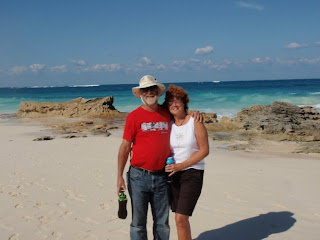
My daughter visited for a week (my personal highlight of the month and one of Bev's also). We established a new kind of relationship with her.


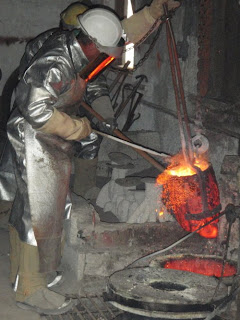
We watched the pouring of bronze sculptures at Little Harbour.



We went snorkelling.


We went sea glass hunting and fought off a wild pig (boar) in the process. It was not really that dramatic but it was scary enough for Bev. Bev made some of the glass into jewelry She also commissioned some of the same.


Bev started a new quilt.
We attnded a flea market and garage sales. We saw a commercial product I did not know existed and still wonder why


Best of all, I celebrated my birthday as I turned 30 for the second time.

I finally got around to installing the fishtail attachment I made for the rudder (see next post) and experimented with its shape.
The generator gave us a few more problems. By the end of the month, we had put over 200 hours on it since leaving Florida.
All other systems performed flawlessly.

We enjoyed nature. The weather was hotter. The sunshine would warm not only your body, but also seemed to penetrate to the soul. Some of the sunsets were so beautiful, they would bring tears to your eyes.

As seen from Tilloo Cay

As seen from Grabbers

Same

Dolphins circling the boat
We had many celebrations of just being alive (aka Happy Hours).

Happy Hour on the R&B Haven - Starboard Watch

Same, Port Watch

The Hosts
We renewed old friendships. We made new ones.

Dinner onboard Zingaro
Scotty and Mary-Lyn, their daughter Christa and son-in law, Mike

Brad and Karen looking sad as usual

BBQ on the beach

Ian and Sharon joining us for dinner
They are from Ottawa

Gerald and Diane as they pass North from the Exumas
Gerald and I worked together for the Canadian Federal Government

New Friends in New Plymouth, Debbie and Jim
The were travelling to the Abacos when we were leaving

More sad times in New Plymouth

The "stage"

A fan with the right attitude

Friends dancing to the music
We were nominted to be charter members of the new Abaco AA Society (Alchohol Appreciation).

Sipping rum and cokes on the beach.
Note, it was so cold, I actually wore jeans

Relaxing on the Flybridge

By the beach at Hope Town

Taking a break from sea glass hunting at Hope Town

At the top of Hope Town Lighthouse

On the beach at Treasure Cay
We watched the pouring of bronze sculptures at Little Harbour.

Clay bust.
A latex/rubber mould would be built around this. After it has been peeled off, it may be re-used many times to create a wax replica of the original sculpture. The wax is then dipped into a stucco like slurry until a female mould is built up. The wax is then melted out. The female mould may then be filled with bronze.

Tin men reparing to pour molten bronze into a mould.
Who said the tin man had no brains.

The pour

A finished product after the mould has been chipped off and the bronze has been artificially aged.

Ian feeding the fish.
He was hoping that if he fed the small fish, it would not attract really big fish (e.g. sharks) who wanted something much more substantial to eat.

fish

fan

Camoflaged snorkler (me)

Porky
Tuk went to sniff him and came back yelping and running on 3 legs.
After checking us out, he walked into the woods. When we came back from sea glass hunting he was waiting for us at the path back to our dingy. I held the boat hook and a net high in the air to look as big as possible while staying between the pig and Bev who had picked up the dogs. The pig kept approaching. Bev threw an old bottle in its direction to scare it. It did not scare. Instead it jumped to the bottle, likely thinking it might be food. As it continued to approach, I poked it really hard in the snout with the boathook. That did not bother the pig in the least. It let us back up to path to the other side of the island and did not follow At least we came away with a good story.

Sea glass pendant made from black glass originating from a 1700s whisky bottle
Bev started a new quilt.
We attnded a flea market and garage sales. We saw a commercial product I did not know existed and still wonder why

Treasure Cay Flea Market

Bev and Tiesha on the way home. Note Tiesha riding in the bag.

Bagged dog

Are these meant as bait? They would be easy to thread onto a hook.

What a dinner: lobster, steak, a salad and a bottle of Rombauer 2007
I finally got around to installing the fishtail attachment I made for the rudder (see next post) and experimented with its shape.
The generator gave us a few more problems. By the end of the month, we had put over 200 hours on it since leaving Florida.
All other systems performed flawlessly.

Morning Coffee
Subscribe to:
Posts (Atom)